

Auckland VBS Increase Effective 1st of August 2023
Please note we have been advised that as of the 1st of August, ContainerCo will be increasing their booking slot fees. Below is an extract from ContainerCo regarding the change in charges:
“ContainerCo has a large investment program ahead that includes gate improvements, handling equipment, and paving systems in exchange areas. To support this program adequately means EBS rates need to be increased”.
Auckland Cartage Increases Effective 1st of August 2023
Due to operational cost increases, as of the 1st of August transporters will be implementing a GRI varying between 5 – 10% on top of Auckland cartage rates. This is because of difficulties in finding, training, and retaining quality staff and drivers, resulting in higher operational costs for transporters.
Auckland Metroport VBS Increases Effective 17th of July 2023
Please note Kiwirail have advised as of the 17th of July, the Auckland Metroport VBS fee will be increased by 20% because of increased operational costs.
Napier Port Increase to Insurance Levy Effective 1st of August 2023
We have been advised that the Port of Napier will be increasing their Insurance Levy fee effective from the 1st of August. The increase to the Insurance Levy is a direct result of the recent increased seismic and weather activity across the region.
MPI Biosecurity Fee Increase Effective 1st of July 2023
The Government has agreed to increase the Biosecurity System Entry Levy to $46.40 and to set a new maximum rate of $50.00. The maximum rate is the highest amount the Director General of MPI can set the levy without further Cabinet decisions. The Government has also agreed to increase the hourly rate for biosecurity fees to $155.50 per hour.
Detention, Demurrage and Storage Invoices Administration Fee
Please note any shipments incurring detention, demurrage and/or storage, Harders will be implementing additional fees to cover the administration and outlay of these costs should we be required to settle these invoices on behalf of the responsible party. The additional fees will consist of a $35.00 Administration Fee as well as a 1.95% Disbursement Fee.
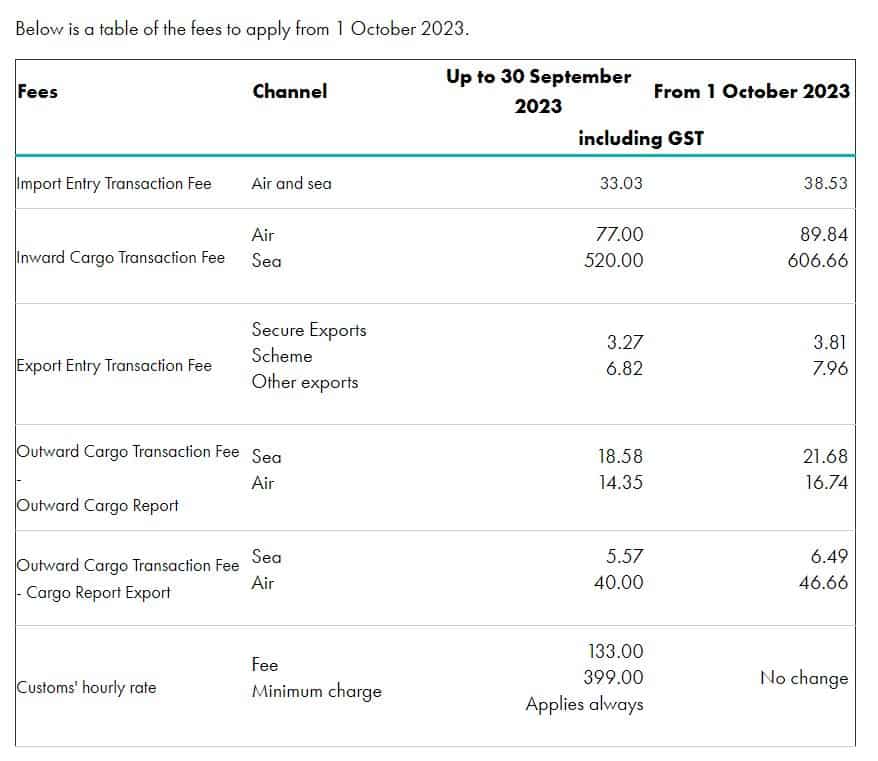
Customs’ Goods Fee Increased to Reflect Inflation on 1st October 2023
Please note the customs’ goods fee are set to be increased to reflect inflation on the 1st of October 2023 as per the below table.
IMPORTANT UPDATE – Import Entry Guidelines for shipments imported under Freight Prepaid Terms (CPT, CFR, CIF, DAT, DAP, DDP)
Please note New Zealand Customs Services will be implementing stricter controls over freight prepaid shipments. With immediate effect all Commercial Invoices (under CPT, CFR, CIF, DAT, DAP, DDP terms) will be required to show a complete breakdown of costs and separately state freight and insurance costs. New Zealand Customs Services will start cracking down on prepaid shipments that do not state the freight and insurance (if applicable) on the commercial invoices. Failure to provide this information may result in clearances being held by NZ Customs until this information can be obtained and may result in possible fines.
It is also imperative that all commercial invoices clearly state the inco-term of the shipment.
Further information is available from: https://www.customs.govt.nz/business/
Airfreight Update
Asia
Overall, the second quarter of 2023 ended with improved volumes compared to the first quarter. Air cargo demand remains soft for general cargo due to being in a traditionally slack season. This is expected to continue into the next month, prior to the anticipated improvement towards the end of third quarter.
There are no capacity issues as more passenger flight capacity has been added to support summer travel demand. Rates continue to remain stable after a gradual uptick with anticipated improvements expected after the end of August and into the end of the third quarter.
Latin America (LATAM)
Capacity is available in all key trade lanes. Due to lower demand, carriers are offering aggressive spot pricing. Contract rates remain stable with little to no change. It is low season on perishable volumes across the region.
United States
Compared to the same period in 2019, direct passenger flights between the United States and China have decreased by 73% so far this year. U.S.-based airlines are currently allowed a total of 12 round-trip flights per week, while China-based airlines had been permitted 8—this number was increased to 12 in early May.
The most efficient flight path between China and the United States passes through Russian airspace, which U.S.-based airlines are not allowed to enter, but China-based airlines can. This gives them a significant cost advantage. As a result, ticket prices on China-based airlines are approximately 40% cheaper than those offered by their U.S. counterparts.
Demand for air freight between the two countries remains relatively low and is manageable with current capacity. However, when additional capacity does return, it is expected to lead to further air rate declines, although it is unclear when this will occur.
Mexico
Felipe Ángeles International Airport (AIFA) in Mexico City, previously only handled domestic flights, is now operating for international cargo arrivals as well. Soon it will also be used for cargo departures. It is estimated that 45% of international cargo will be handled by AIFA and the remaining portion by Mexico City International Airport (AICM).
Ocean Freight Update
Ocean freight demand on most trade lanes is generally flat, with slight changes up or down. Overall vessel capacity continues to trend higher than demand, keeping rates from long- lasting or significant increase. As such, the steamship lines will continue voiding sailings and slow steaming. This allows them to allocate more vessel/capacity per service and save on bunker costs.
One trade lane currently standing out is the Trans-Pacific. It is a good reminder of how the timing of an event (in this case, a port strike) outside of supply and demand can disrupt a market for a period of time.
Despite this, the global outlook on the longer term continues to point to a market imbalance.
New vessel deliveries accounted for a record-breaking 285,000 TEUs of slot capacity entering the global liner fleet in the month of June alone and deliveries will continue in the coming months.
Year to date, roughly less than 90,000 TEUs worth of container ships were scrapped. Even when adjusted for blank sailings and planned service suspension, the coming months show a continued year over year capacity increase on the major East-West trade lanes.
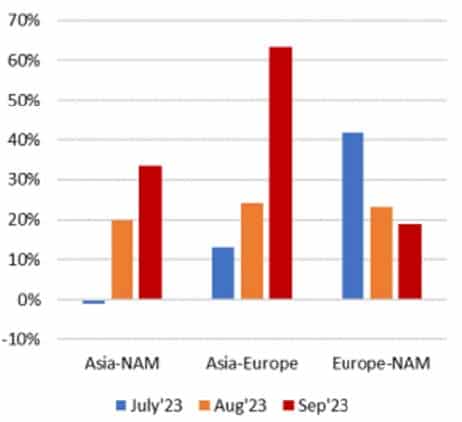
Carriers are implementing more slow steaming strategies, which are affecting transit times and disrupting schedules. They are looking to achieve three outcomes:
- Save on fuel costs
- Address overcapacity by adding more vessels to service strings and avoid parking vessels
- Comply with IMO 2023 regulations for older, non-compliant vessels, which is affecting transit times and disrupting schedules
Make sure that you account for these potential changes in your international freight.
Asia
Carriers continue to push for twice-monthly rate increases in the Trans-Pacific lane. For the first time in over a year, July have seen two GRIs implemented successfully. Several factors have made this happen:
- Carriers blanking 14% capacity to the U.S. West Coast (USWC) vs. June.
- Seasonal demand increase entering summer due to back-to-school and holiday goods.
- Panama Canal low draught restrictions limit capacity to the U.S. East Coast (USEC) and U.S. Gulf Coast (USGC).
- Service withdrawals: Zim North Pacific (ZNP) service withdrawal in July is taking out about 1% capacity to the USWC. The Alliance is also planning the suspension of the PS5 service in August.
- Canada West Coast ILWU strike is shutting down two ports, effectively removing capacity as ships anchored or drifting have stopped their rotation and are not an option for space. It also creates a rail backlogue and volumes shift to other North American ports, increasing the demand on other services.
Consequently, booking delays and cargo rollover at origin are happening on some Trans- Pacific lanes.
Asia to Europe rates continue to fall, with rates to the Mediterranean starting to come under pressure.
Europe
Labour actions/social movements may continue to happen in Europe.
July is the beginning of the summer holidays in Europe; and activity is expected to slow down overall until September.
The port of Mersin continues to experience significant congestion in the aftermath of the severe earthquakes that hit Turkey in 2022. Vessels are delayed by 7-10 days while awaiting a berth.
Contrary to the overall soft market trends between Asia and Europe, volume from Asia to the Mediterranean continues to be strong overall. Much of the volume was to East Mediterranean/Baltic ports, rather than West Mediterranean ports.
Carriers are looking to add more capacity to the Asia-Mediterranean trade lane because of this growing demand, which has created optimism among some observers that the Asia-Europe lanes may see a high season this year.
Latin America
Due to low water levels at the reservoir feeding the Panama Canal, draught restrictions have been in place since April 2023 on the TPEB trade for U.S. imports, these are effective starting 1 August 2023. No surcharges have been announced on any U.S. export trade lanes. The area has received some much-needed rain, which should improve water levels and possibly avert the need to add further draught restrictions, which were set to go into effect 9 July 2023. Expect more updates as they are received.
Hazardous cargo is under strict scrutiny regrading package marking/labelling. Approvals take longer and rolling happens more frequently.
U.S. – LATAM
Space is generally open, (ex USEC to East Coast South America (ECSA) ports). CMA’s New Americas XL service, which went into effect in the first quarter of 2023, is the first direct service (ex USEC to West Coast South America (WCSA)) in several years.
Space (ex USGC to LATAM ports) is much more open, with several new services introduced early in 2023. The U.S. export market is softening and space is more open. Carriers are working to absorb excess vessel capacity.
North America
Wildfire season has started in Canada and is already widespread. This year’s wildfires are the worst since 1995, causing disruptions to truck and rail operations throughout the country, but especially in Alberta and British Columbia. Canada remains vigilant with regards to the likelihood of recurrent fires in Alberta, with potential wildfires in Nova Scotia and northern Ontario.
The other side of the country is experiencing heavy rains and possible flooding, which extends into the northeastern United States. Additional rain is expected in the forecast. Expect inland operations to be affected.
A tentative four-year agreement has been reached between the British Columbia Maritime Employers Association (BCMEA) and IWLU Canada, which should put an end to the near two week-long labour strike at the ports of Vancouver and Prince Rupert. The agreement has not yet been ratified and details of the agreement are not available at the time of this writing. It will take time for normal operations to resume, as well as for the congestion to clear.
Potential future factors to monitor:
- Export staged cargo will take priority to enter ocean terminals when operations resume.
- Strong pipeline of empties on the rail to the west coast will limit the ability to reduce Vancouver inland dwell.
- The import surge may place pressure on trucking drayage capacity, affecting CN storage and demurrage situations.
- Full and empty capacity out of Toronto will be slow to open due to the above point, adding pressure to the inland depots.
- Import surge of cargo from west to east will create congestion in Toronto and require immediate empty storage requirements.
Oceania
The Trans-Tasman market has softened. Space and equipment availability is open. Rates are dropping with the introduction of new options on this trade lane.
Direct carrier space is improving (ex USEC and USWC) while transshipment service options are widely available. Rates are softening due to improving space availability. High season on this trade lane begins in late August/early September so space may tighten in the near future.
Space from the USEC with direct carriers is improving and space is now available 2-3 weeks out.
Direct carrier service out of USWC ports has even more open space and booking on shorter notice is possible. Vessels have resumed calling Auckland port (ex. USWC) on a weekly basis.
The Oceania to Europe market remains stable, with space and equipment readily available for dry cargo. Rates are still gradually being reduced by all carriers as supply continues to outweigh demand.
South Asia, Middle East, and Africa
Cyclone Biparjoy caused significant flooding and damage in the Gujarat coastal region of India (which includes Mundra/Pipavav ports) and Pakistan (including Karachi port). Port and inland operations were significantly affected by this weather event, so anticipate that some disruptions and backlogs will persist in the coming weeks.
Space continues to be very tight out of USWC on this lane, making it important to book 3-4 weeks in advance. However, with several carriers announcing they are re-opening space and service into this market, expect space availability to improve during the coming quarter. Space is most readily available (ex USEC ports (particularly New York and Norfolk)) where there are more direct services.
Space (ex USGC ports) continues to be very tight, but it has improved slightly with the reinstatement by CMA and COSCO of their MedGulf service (ex USGC (Miami and Houston) ports). This service provides connections from USGC ports to India subcontinent destinations and adds a needed additional carrier option.
We will continue to evaluate all market options and work with you to provide individual solutions for your business.
For more details on any of these articles please contact your Harders Key Account Manager.