

Industry Outlook
The macroeconomic environment has been better than predicted over the first half of 2023, but the second half of the year is expected to be weaker.
The impact of past monetary policy tightening is beginning to show an effect as the global economy begins to slow. Both Europe and the United States have started 2023 off with more robust GDP numbers than expected, but most forecasters expect growth to be more downbeat through the remainder of 2023.
US consumers have up until now proved surprisingly resilient to high inflation and higher borrowing cost, which has carried goods consumption further than most had expected. The main reason for this is labour markets are holding up more robustly, with unemployment close to historical lows, helping hold up consumer demand. Another reason for this resilience is excess savings accumulated by consumers during the pandemic.
In Europe, the near-term activity indicators and consumer confidence have improved from the lows in Q3-Q4 2022 and point to a mild growth acceleration heading into Q2 driven by the services sector. With that said, the cyclical outlook remains challenging as inflation remains high and sticky, unemployment remains at historical lows, credit conditions are tightening, inventories remain elevated and the external outlook is challenging.
In China, Q1 GDP data came in stronger than anticipated, driven by a post-Covid reopening bounce in services sector activity that has materialized faster than most anticipated. The manufacturing sector has also seen a Q1 bounce in activity, likely driven by backlogs from the Zero-Covid period, but has fallen back into contraction territory in April. The services PMI also fell back in April and, although the level remains elevated, this could suggest that the pace of recovery is now slowing.
IMPORTANT UPDATE – Import Entry Guidelines for shipments imported under Freight Prepaid Terms (CPT, CFR, CIF, DAT, DAP, DDP)
Please note New Zealand Customs Services will be implementing stricter controls over freight prepaid shipments. With immediate effect all Commercial Invoices (under CPT, CFR, CIF, DAT, DAP, DDP terms) will be required to show a complete breakdown of costs and separately state freight and insurance costs.
New Zealand Customs Services will start cracking down on prepaid shipments that do not state the freight and insurance (if applicable) on the commercial invoices. Failure to provide this information may result in clearances being held by NZ Customs until this information can be obtained and may result in possible fines.
It is also imperative that all commercial invoices clearly state the inco-term of the shipment.
Further information is available from:
https://www.customs.govt.nz/business/import/
Australia and UK sign Free Trade Agreement
The Australia-United Kingdom Free Trade Agreement (FTA) is the UK’s first new trade deal signed since Brexit. The agreement, which went into effect on 31 May 2023, will remove tariffs on over 99% of goods traded.
As a modern and comprehensive free trade agreement, the AUKFTA’s 32 chapters cover the full scope of trade and regulatory matters, as well as reaching into new areas like gender equality and animal welfare.
Australian amendments to the Harmonized System (HS) chapters dealing with chemicals, building materials, vehicles and the textile, clothing and footwear chapters see few changes from most favoured nation duty rates. However, there is an immediate elimination of tariffs on goods that focus on the agriculture sector including wine, rice, honey, nuts olive oil, seafood, produce and processed foods.
Similarly for the UK, there is an elimination of tariffs on all food products including UK biscuits, whisky, and gin exports (previously 5%) and cheese (previously around 20%). UK manufacturers will also benefit from tariff-free exports, flexible Rules of Origin and simplified customs procedures. The UK’s vehicle manufacturers exported automotive goods worth £343 million to Australia in 2022 and will now benefit from all Australian automotive tariffs being cut to 0%.
Indo-Pacific Economic Framework talks result in tentative deal
The recently held Indo-Pacific Economic Framework (IPEF) ended with a deal ‘substantially completed’. The IPEF talks were attended by trade ministers of 14 Asia Pacific countries and were aimed at helping make supply chains more resilient and secure.
This agreement would represent the first of its kind and in practice would see countries forming a council in order to ensure supply chain activities remain coordinated. Additionally, a ‘Crisis Response Network’ would help give countries advance warning of supply chain disruptions.
Smartphone industry getting back on track
Global smartphone shipments have been hit hard over the recent period, with a 9.6% year- on-year drop in 2022. However, the market is finally stabilizing, with 2.4% growth expected in 2023. This growth trend is expected to continue, with a forecasted CAGR of 1.5% from 2023 to 2028, exceeding 1.3 billion annual shipments by 2025. While trade wars, inflation issues and supply chain troubles will continue to present a challenge to the sector, the increasing affordability of 5G technology, coupled with quickly growing markets like India, should offset the challenges and result in overall growth.
Airfreight Update
Asia
Air freight capacity continues to recover and increase, especially with the upcoming Northern Hemisphere summer holidays. With the exception of ecommerce cargo, which continues to see stable demand, general cargo demand growth remains weak—despite the anticipated quarter-end increase in volume. Rates are still holding and remain stable.
North America
Compared to the same period in 2019, direct passenger flights between the United States and China have decreased by 73% so far this year. U.S.-based airlines are currently allowed a total of 12 round-trip flights per week, while China-based airlines had been permitted 8—this number was increased to 12 in early May.
The most efficient flight path between China and the United States passes through Russian airspace, which U.S.-based airlines are not allowed to enter, but China-based airlines can. This gives them a significant cost advantage. As a result, ticket prices on China-based airlines are approximately 40% cheaper than those offered by their U.S. counterparts.
Demand for air freight between the two countries remains relatively low and manageable with current capacity. However, when additional capacity does return, it is expected to lead to further air rate declines, although it is unclear when this will occur.
Global Freight Update
Ocean freight demand on most trade lanes is generally flat, with slight changes up or down. Overall vessel capacity continues to trend higher than demand.
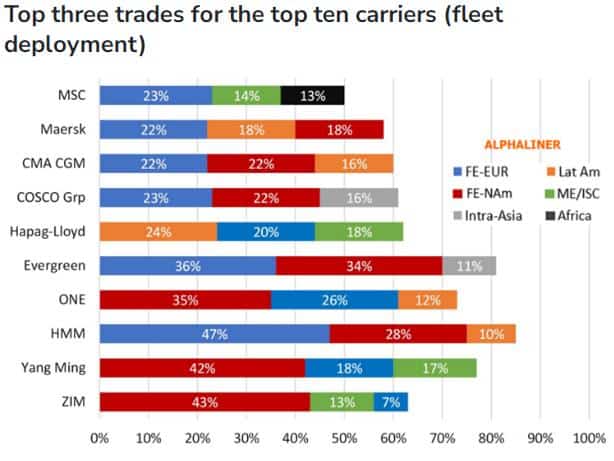
The steamship lines are trying their best to spread their fleets to the markets that make the most sense for them in terms of volume and revenue while managing the post-pandemic lull with the least possible impact. They will keep voiding sailings and slow steaming on the backhaul legs of major east-west services. This allows them to allocate more vessel/capacity per service and save on bunker costs.
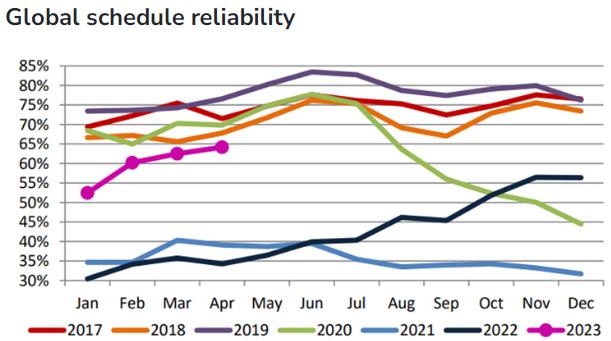
Global schedule reliability continues to improve. The main east-west trade lanes (Trans- Pacific, Asia-Europe, Trans-Atlantic) all show positive trends. Yet a lot of attention is currently targeted to the U.S. West Coast, as the negotiations between the Pacific Maritime Association and the ILWU cause tensions and operational slowdowns. Should the West Coast become congested, vessel and rail capacity into North America would contract, leading to transit delays and rate increases on the related lanes.
The Panama Canal is imposing lower draught restrictions due to drought conditions/falling water levels at nearby lakes that form part of the waterway. The restrictions went into effect at the end of April. This means container delivers seeking to cross the canal connecting the Atlantic and Pacific oceans must reduce their payloads. This will have the impact of tightening vessel space as carriers will have to load less cargo on these routes.
Asia
Carriers once again implemented a general rate increase (GRI) on the Trans-Pacific trade on 1 June, 2023. This is the second post-pandemic increase after the 15 April 2023 GRI. While the GRI was initially successful, the rates a steadily moving back down each day.
MSC continues to add more capacity. Its total capacity finally breached 5 million TEUs at the end of May. It will launch a new Swan service in June, deploying 14,000 ships that would boost weekly capacity between Asia and North Europe by 5%.
The USWC port disruptions continue to be a distraction, with no resolution on a new ILWU contract after more than one year of negotiations. Should the West Coast become congested, vessel and rail capacity into North America would contract, leading to transit delays and rate increases.
Europe
There is generally more capacity supply than space demand on trade lanes out of Europe. This trend continues, which is further driving ocean freight rates downwards.
The backhaul lane to Asia has reached very low rate levels, while export rates to North America are back to pre-pandemic levels.
Labour strike actions have tapered down in Europe.
North America
On the U.S. West Coast, some of the terminals closed for several shifts beginning in June. There is ongoing uncertainty as negotiations between the Pacific Maritime Association and the ILWU continue, almost a year after expiration of the contract between the two parties. When the terminals are opened, operation slowdowns may happen. If this trend worsens, a backlog of freight could appear, tightening space and rates into the United States—both on the coast and inland due to consequent rail delays.
Demand into the United States and Canada is rather steady overall, similar to 2019 volumes, which were much lower than during the pandemic years.
Oceania
Trans-Tasman
The Trans-Tasman market has softened. Space and equipment availability is open. Rates are dropping with the introduction of new options on this trade lane.
U.S. to Oceania
The market continues to weaken. Rates are continuing to be reviewed as carriers compete for market share. Space continues to be tight on the USEC but easing on the USWC. There are no delays from any inland rail points, equipment is steadily available.
Port calls to New Zealand for exports from the USWC have been upgraded to weekly and transshipment service options are increasing with reduced congestion through Asian ports.
Europe
The Europe export market remains stable, with space and equipment readily available for dry cargo. Rates are still gradually being reduced by all carriers as supply continues to outweigh demand.
Asia
Ocean carriers operating between Northeast Asia and Oceania are still experiencing low rates. They continue to implement certain measures in preparation for the next GRI scheduled for mid-June—increasing blank sailings (cancelling entire vessel sailings) or even temporarily suspending services to bolster their position.
SEA has provided notification of a carrier of transship port omission, so carriers are also starting to look at SEA capacity/rate levels.
South Asia, Middle East, and Africa
The demand out of India, Bangladesh and Africa is steady, yet vessel capacity is in excess. This results in flat to lower rates levels.
Demand out of the Middle East is a little bit more volatile, with Latin America (LATAM) and Asia rates on an upward trend.
The recent political unrest in Pakistan continues to evolve. The city of Karachi is under control. In the north, (Lahore, Faisalabad, Islamabad and Sialkot) the situation is slightly elevated and suppliers/shippers are exercising caution to ensure the safe transportation of goods. In Pakistan, demand is consequently very slow.
We will continue to evaluate all market options and work with you to provide individual solutions for your business.
For more details on any of these articles please contact your Harders Key Account Manager.