

New Zealand Overview
Air Terminals
- Menzies is currently operating under normal conditions with no reported disruptions.
- Air New Zealand transitioned to a new operating system earlier this week, which initially resulted in some operational disruptions. However, the issues have since been resolved, and operations appear to have stabilised.
Landside
- The BMSB Season ended on the 30th of April.
- The Interisland Ferry, Aratere, is due to be retired later this year to allow infrastructure changes in preparation for the replacement ferries expected in 2029. This affects Rail freight between North and South Island both ways.
KiwiRail has Temporarily paused new passenger and freight bookings for travel from 9 September 2025 onwards while they update their timetable and cargo allocations.
Subject to scheduling adjustments, the Strait will lose 26 sailings a week, including 10 freight-only trips.
Air Freight Update
North America
Imports
- Consols are moving as booked with capacity available on most carriers.
- Airfreight rates for consol cargo have remained stable throughout the month, with no significant pricing fluctuations.
Exports
- Capacity is extremely limited, with current backlogs extending beyond 7-10 days. This is due to a significant reduction in services to/from New Zealand over the winter period.
- Delta Airlines have reduced its service from daily flights to three flights per week started 31st March and will suspend AKL to LAX flights from 22nd May.
- United Airlines currently has a space backlog of 7 to 10 days.
- Air New Zealand direct services from Auckland generally have good space availability.
Europe
- Consols are generally moving according to schedule, with most carriers currently offering sufficient capacity. However, some shipments are experiencing minor transit delays, typically ranging from one to three days, due to occasional operational bottlenecks or routing adjustments.
- Rates from Europe to Auckland are experiencing significant fluctuations, primarily driven by a combination of strong demand and limited cargo capacity. As shipping volumes continue to rise, the constrained availability of space on outbound flights is placing pressure on pricing, making the market increasingly volatile and competitive.
Exports
Capacity is expected to tighten as the ripple effect of U.S. airline service reductions begins to impact transatlantic routes.
Asia
Imports
- Capacity constraints persist from several origins due to ongoing ocean freight delays and the subsequent shift of cargo to air transport. Particularly in Guangzhou, where the increase in airfreight demand continues to strain available capacity.
- High demand and limited space availability are driving continued fluctuations in airfreight rates, with pricing remaining volatile across several key trade lanes.
Exports
Consols are moving as booked, with capacity available on most carriers.
Trans-Tasman
Imports
- Consols are moving as booked, with capacity available on most carriers.
- Due to the ongoing implementation of heightened security measures in Melbourne, shipments of dense cargo continue to experience delays. These screening procedures have introduced additional handling times and associated costs. Final approval for the uplift of such cargo now rests solely with the terminal.
Exports
Consols are moving as booked, with capacity available on most carriers.
Ocean Freight Update
Asia
Import
At the time of writing this, the ceasefire between India and Pakistan seems to have reduced the risk of further hostilities however the impacts to the supply chain have started to be felt with both ANL (CMA-CGM) and MSC announcing surcharges for containers departing Pakistan. These surcharges are more driven from political challenges, rather than as a result of risk as India is restricting the access to its ports of vessels that have previously called Pakistani ports – this means that lines have had to rework some of their feeder services from Pakistan (hence the surcharges).
Overall the market from Asia to New Zealand does seem to be somewhat flat and, a s a result, we are beginning to see shipping lines withdrawing some capacity, which will likely result in upward pressure on rates. Already we see MSC restricting bookings on the Wallaby service to NZ and various blank/sliding sailings on other services.
Congestion at the big Chinese ports is notable, with the trade war causing some shippers to delay departures of some containers. Whilst this doesn’t have a direct impact on Oceania, this may become an issue down the track with empty container shortages and general congestion slowing down port operations.
Export
- Port congestion in Colombo is significant causing delays of 2+ weeks.
- Some Carriers are experiencing transhipment delays in Singapore of 2-3 weeks.
- Space remains tight on most service to and via Asian ports – we recommend booking at least 6 weeks in advance in order to secure.
- Reefer space and equipment is scarce.
Trans-Tasman
Import
- 20’ containers are still in short supply across Australia. Please speak with your Customer Services Representative for options.
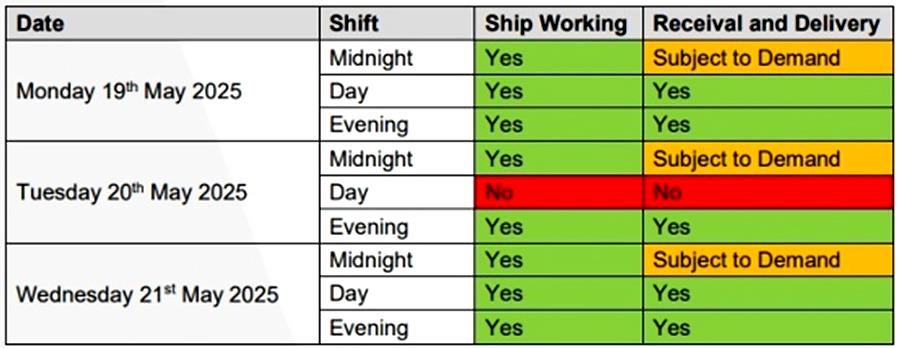
- Patrick Terminal Fisherman Islands. All ship and yard operations will cease between 0700 – 1500hrs on Tuesday 20th May 2025 to conduct yard infrastructure and system maintenance.
Export
Most NZ export services have immediate availability.
Europe
Red Sea is still at risk of attacks by Houthi rebels. Maersk and CMA have not announced any return to the Suez Canal. Services continue to sail around the Cape of Good Hope.
Import
- BMSB season is over.
Congestion at Port of Antwerp, Rotterdam, Hamburg and Bremerhaven will take 6-8 weeks to clear. - The “Labour Slowdown” in Rotterdam has been called off and the terminals are back to capacity.
- Vessels are off window arriving into Europe from the Cape of Good Hope. On time arrivals are as low
as 21%. This is causing the weekly schedules to be disrupted. - 20’ reefers are in low supply across Europe.
Export
- Vessels are heavily booked, bookings need to be made 5-6 weeks in advance.
- Reefer space and equipment is scarce on NZ export services to Europe.
- European ports are heavily congested.
North America
- Vancouver – No berthing delays. Import rail dwell average has increased slightly to 4.7 days.
- Panama Canal services for ANP/OC1 service – Vessels are heavily booked 4+ weeks in advance of departure. Congestion in Cartagena is resulting in delayed transhipment, delays vary depending on the Carrier.
US Terminal Operations:
New York – berthing is delayed by 6 hours. Alternative depots have been made available to assist wi th dehiring empty containers and chassis’.
Charleston – berthing delay of 6 hours.
Savannah – average wait time for a berth is 2 days.
Houston – waiting time of 6 hours for a berth.
Oakland – berthing delays of 4 days, OICT now have 3 cranes that are out of order.
Seattle – No berthing delays. Terminal 18 is now open 5 days per week having previously closed on Fridays. Rail import dwell time is 2.1 days.
Long Beach – Congestion on port is seeing delays of 4-8 days.
Export
- Reefer space and equipment is scarce on NZ export services.
- West Coast North America – there is no departure in week 15. The next Seattle vessel after the Mate v 521N, ETD Tauranga 12/6 is the CMA CGM Dutch Harbor 523N scheduled to depart Tauranga 3/7.
Customs Update
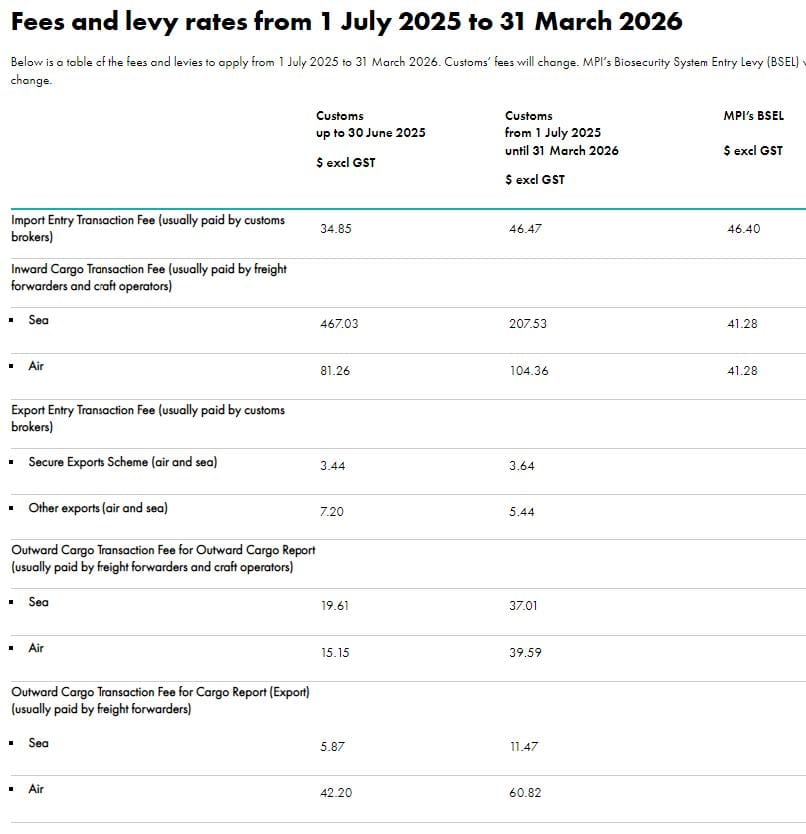
Customs’ goods fee rates will change on 1 July 2025.
Cabinet has approved changes to the fees and levies that the New Zealand Customs Service (Customs) and the Ministry for Primary Industries (MPI) charge to recover the costs of managing goods crossing our border.
For more specific information / requirements please ask your Harders NZ Key Account Manager.
We will continue to evaluate all market options and work with you to provide individual solutions for your business.