

Brown Marmorated Stink Bug Season 2023-2024
Fumigation / Heat Treatment will be required for all high risk commodities from Italy and a few selected commodities from other origins effective from the 1st of September to 30 April 2021. The shipped on board date, as indicated on the Ocean Bill of Lading is the date used to determine when goods have been shipped.
As per industry draft consultation, The Ministry for Primary Industries (MPI) has proposed the BMSB 2023-24 seasonal measures will apply to target vehicles, machinery and parts (VPM) exported from risk countries, on or after 1 September 2023, and which will arrive in New Zealand before or on 30 April 2024; to vessels that berth, load, or tranship from target risk countries within the same period.
Brown marmorated stink bug: requirements for importing vehicles, machinery, and parts.
BMSB target goods must be fumigated offshore before arriving to New Zealand.
There is one exception to this rule: BMSB management is not required if target vehicles, machinery, and parts are loaded into a fully enclosed container which is sealed before 1 September and then exported before 1 October of the same year.
To use this exception, evidence will need to be provided of container sealing in the form of the seal number and a date-stamped photo. More details can be found under the import health standard.
BMSB management measures apply if you’re importing target vehicles, machinery, or parts from the countries listed in schedule 3 of the import health standard (issued 12 August 2021).
The 38 countries are:
- Albania
- Andorra
- Armenia
- Austria
- Azerbaijan
- Belgium
- Bosnia and Herzegovina Bulgaria
- Canada Croatia Czechia France Georgia
- Germany
- Greece
- Hungary
- Italy
- Japan
- Kazakhstan
- Kosovo
- Liechtenstein
- Luxemburg
- Republic of North Macedonia Moldova
- Montenegro Netherlands
- Poland
- Portugal
- Romania
- Russia
- Serbia
- Slovakia
- Slovenia
- Spain
- Switzerland
- Turkey
- Ukraine
- USA (excludes Alaska and Hawaii)
Napier VBS Increase Effective 1st of September 2023
Please note we have been advised that as of the 1st of September, the VBS fees for Napier will be increased to be in line with Port of Tauranga, Metroport, and ContainerCo booking charges and no show fees.
The VBS fees include the recovery of the direct cost applied by the Port and/or Depot, administration to complete the booking (often in multiple stages of securing a slot, allocating a valid container number or release, and then manifesting to truck registration), and the recovery of penalties applied by Ports and Depots.
Not all container yards use the same software and some software applications used by Ports and Depots introduce more administration and friction than others.
Auckland VBS Increase Effective 1st of January 2024
Effective from the 1st of January 2024 the total VBS Container Access charge for bookings at Port of Auckland will increase again. Reason provided by the Port of Auckland as per below:
For years, Port of Auckland has been under-recovering inflationary pressures and costs through its annual tariff adjustment. We need to continue to apply higher increases to some charges so that we can start to generate a fair return on investment. POAL group has around $1.6bn of assets, which will ultimately need to generate a return of $80-100m NPAT (net profit after tax) annually to replace assets as they wear out. A business that does not generate sufficient return will ultimately be forced to close, which is clearly not acceptable for a key supply chain link such as a port.
Port of Auckland’s container terminal investment makes up around half of its total assets, but in FY22 generated a $25m loss at NPAT level. There has been significant improvement in FY23 to almost breakeven level, due to increased access fees but also one-off demurrage revenue as the supply chain was excessively congested. The supply chain is now moving more freely, and demurrage charges have fallen back to historic levels, positive for customers and cargo owners but negatively impacting POAL profitability.
In addition to the increase in the total VBS Container Access fee, there is a review underway for overall access fee recovery across the port which will apply to all stakeholder groups accessing the port in the coming year. Further, we will introduce a rail handling fee and increase to the Infrastructure Levy charged to Lines, applicable from January 2024. These pricing adjustments are critical if we are to work towards achieving a fair return on the port’s asset and to its shareholder.
A further confirmation of the above-mentioned rates will be provided when our Public Tariff review is completed and announced in early October 2023. In the interim, we wish to provide you with a longer notice period of this intended change to the VBS Container Access fee.
COSCO Shipping Lines – Terminal Handling Increase Effective 1st of October 2023
Please note Cosco Shipping Lines has confirmed they will be increasing their Terminal Handling Charges for shipment to and from New Zealand effective from the 1st of October 2023.
IMPORTANT UPDATE – Import Entry Guidelines for shipments imported under Freight Prepaid Terms (CPT, CFR, CIF, DAT, DAP, DDP)
Please note New Zealand Customs Services will be implementing stricter controls over freight prepaid shipments. With immediate effect all Commercial Invoices (under CPT, CFR, CIF, DAT, DAP, DDP terms) will be required to show a complete breakdown of costs and separately state freight and insurance costs. New Zealand Customs Services will start cracking down on prepaid shipments that do not state the freight and insurance (if applicable) on the commercial invoices. Failure to provide this information may result in clearances being held by NZ Customs until this information can be obtained and may result in possible fines.
It is also imperative that all commercial invoices clearly state the inco-term of the shipment.
Further information is available from: customs.govt.nz/business
Airfreight Update
Asia
In the midst of summer holidays, ample passenger capacities have been added to the market. At the same time, freighter capacity has been removed on an ad hoc basis due to the usual ongoing C-checks.
Demand is in the traditional slack season, remaining relatively flat and weak. Expect this trend to continue into September, when there may be a gradual demand increase toward the end of Q3.
Plan for relatively stable rates to continue toward the end of the year, keeping in mind, this is subject to high season demand shifts, which may influence how rates develop. With demand remaining low and increased indirect passenger capacity, freighter cancelations are common.
Europe
Transatlantic capacity and demand are relatively stable. The overall low demand keeps the market relatively stable for both United States and Europe exports. Capacity on passenger aircraft is at its peak during this high-travel demand period. Due to the decreased demand, there are many opportunities for cost savings in the spot market.
Though precise dates have yet to be announced, EUROCONTROL, which is responsible for managing European airspace, warns of possible air-traffic control labour strikes through the summer. A prolonged strike would have implications across Europe. Watch for updates as they become available.
Oceania
Capacity to Oceania continues to grow, however there are some capacity restraints caused by Northern summer season traveller and additional fuel loads required—particularly from North America on direct flights. Softening of these restrictions and further additional capacity is expected as Q4 approaches.
There are fewer restrictions from both Europe and Asia to and from Oceania and ample support for cargo demand.
The export market is softer overall to most destinations.
Latin America (LATAM)
There is currently ample capacity in all major trade lanes in this region. The surplus is a result of reduced demand, prompting carriers to offer competitive spot pricing options. Despite these fluctuations, contract rates have maintained their stability with minimal to no adjustment. The ongoing low season for perishable goods across the region has also contributed to this.
Consequently, the demand for northbound cargo remains low since perishables are in their seasonal low. Conversely, southbound capacity originating from Miami is widely accessible for most markets. This situation has also led to the availability of aggressive spot pricing in the majority of lanes, providing potential benefits for shippers.
Unites States
Export demand from the United States remains relatively stable with capacity available. Some capacity from the United States to Asia has been re-positioned to California and Washington to support cherry season demand, which could create some capacity issues for shippers that require freighter flights elsewhere.
As Q4 approaches, there will be some capacity exiting the market due to decreased passenger travel demand.
Ocean Freight Update
Ocean freight demand on most trade lanes is generally flat, with slight changes up or down. Overall vessel capacity continues to trend higher than demand, keeping rates from long- lasting or significant increase. As such, the steamship lines will continue voiding sailings and slow steaming. This allows them to allocate more vessel/capacity per service and save on bunker costs.
One trade lane currently standing out is the Transpacific. Despite a rather moderate demand uptick during high season, carriers in this lane have managed four consecutive rate increases. It is a good reminder of how capacity management from the carriers, combined with the momentum of external events (port congestion due to labour strikes, Panama Canal restrictions etc.), can quickly shift the balance of supply and demand.
Asia
The Transpacific market is expected to remain strong through August with high vessel utilisation allowing carriers to push for a fourth consecutive rate increase in mid-August. Vessels are full several weeks out. Booking delays and cargo rollover at origin may happen if the vessel arrives late, sees a blank sailing or if the booking shortfall expected by the carriers that week is less than forecasted.
U.S. West Coast (USWC) and U.S. East Coast (USEC) capacity is expected to pick up slightly in September, while inland port intermodal (IPI) moves may need longer time before improvements occur.
The port labour dispute in Canada officially ended on 4 August, 2023 and the backlog has started to clear up in Puget Sound, Vancouver and Prince Rupert.
The Asia-Europe 1 August 2023 general rate increase (GRI) was successful, however rates have started to decline. Many steamship lines are planning to introduce fresh capacity on this route in the coming month.
Europe
Labour actions/social movements may continue to happen in Europe.
August is the peak of the summer holidays in Europe. Accordingly, activity is expected to be slow overall until September. Yet, as rate levels have reached unsustainable levels for carriers, some are attempting minor increases. While these are unlikely to go through, carriers are sending a signal to the market that they may put further effort on capacity management on this lane in the future.
The congestion in Turkey at the port of Mersin continues to improve since sustaining significant earthquake damage in 2022.
Latin America
Rates out of LATAM are generally stable to down.
Rates to Asia and India are decreasing as carriers look to reposition equipment to these destinations for their exports out of these regions. If they don’t find freight to export from LATAM, they find themselves having to deliver empty containers for the sole purpose of repositioning equipment.
The strongest demand destinations out of LATAM are Europe and North America. Yet, steamship lines may still not be able to increase rates on these lanes as they are competitively looking for volumes.
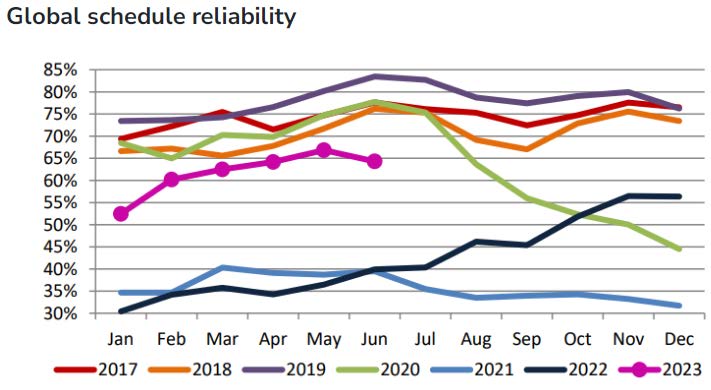
In terms of schedule reliability, there’s a noticeable increase in instances of slow steaming, service cancellations and blank sailings. Carriers are adopting these measures to exert control over capacity. Meanwhile, the challenge of equipment shortages continues to persist at rail ramps.
In evaluating export transits and dwell times, distinct patterns emerge across different regions. The West Coast faces sailing delays of five to seven days, contributing to transit time challenges. The East Coast presents a comparatively clear picture in terms of these transit and dwell time considerations.
Hazardous cargo is under strict scrutiny regarding package marking/labelling. Approvals take longer and rolling happens more frequently.
U.S. – LATAM
Space (ex. U.S. Gulf Coast (USGC) to LATAM ports) is much more open, with several new services introduced early in 2023. The U.S. export market is softening and space is more open. Carriers are working to absorb excess vessel capacity.
A significant development has unfolded in the form of open space to LATAM markets. This shift is attributed to the introduction of new services, consequently leading to a downward trend in rates. This evolving scenario provides a unique opportunity to tap into the LATAM markets more effectively.
U.S. – India/Middle East
Space continues to be very tight out of USWC to SAMA, making it important to book 3-4 weeks in advance. However, with several carriers announcing they are re-opening space and service into this market, expect space availability to improve during the coming quarter. Space is most readily available (ex. USEC ports—particularly New York and Norfolk) where there are more direct services.
Space (ex. USGC ports) continues to be very tight but has improved slightly with the reinstatement by CMA and COSCO of their MedGulf service (ex. USGC—Miami and Houston—ports). This service provides connections from USGC ports to India destinations and adds a needed additional carrier option.
Oceania
The Trans-Tasman market has softened. Space and equipment availability is open. Rates are dropping with the introduction of new options on this trade lane.
Direct carrier space is improving (ex USEC and USWC) while transshipment service options are widely available. Rates are softening due to improving space availability. High season on this trade lane begins in late August/early September so space may tighten in the near future.
Space from the USEC with direct carriers is improving and space is now available 2-3 weeks out.
Direct carrier service out of USWC ports has even more open space and booking on shorter notice is possible. Vessels have resumed calling Auckland port (ex. USWC) on a weekly basis.
The Oceania to Europe market remains stable, with space and equipment readily available for dry cargo. Rates are still gradually being reduced by all carriers as supply continues to outweigh demand.
South Asia, Middle East, and Africa
Carriers have increased capacity management efforts out of India leading to increasing rate levels.
As an example, out of South India and Sri Lanka, carriers may have elected to give more space to connecting Asia freight, which is currently more profitable. Consequently, they are cutting the local allocations, which helps balance supply and demand, leading to the ability to increase rate levels to North America. They are also pushing for rate increases out of Northwest India and using blank sailings to manage the capacity.
The most challenging destinations out of Africa and the Middle East are to North America, Europe and LATAM. Transit times become highly volatile when there are several transshipment points on a given route.
Book 2-3 weeks in advance on eastbound and westbound freight from ocean ports. In India, if delivering from inland origins book 3-5 weeks in advance.
The port of Mundra continues to struggle with severe port congestion in the aftermath of Cyclone Biparjoy, which struck the region in June. Expect delays to deliveries and vessel schedules to continue.
We will continue to evaluate all market options and work with you to provide individual solutions for your business.
For more details on any of these articles please contact your Harders Key Account Manager.